Skip to content
EN
Book a demo
For padel and tennis academies and schools

Your students sign up, you build the groups

No more spreadsheets, start-of-season forms or bank transfers to tick off. Families sign up and pay online: camp, season course or private lesson. You build the groups and plan instructors and courts in every club where you teach — whether or not it is on SportFinder.

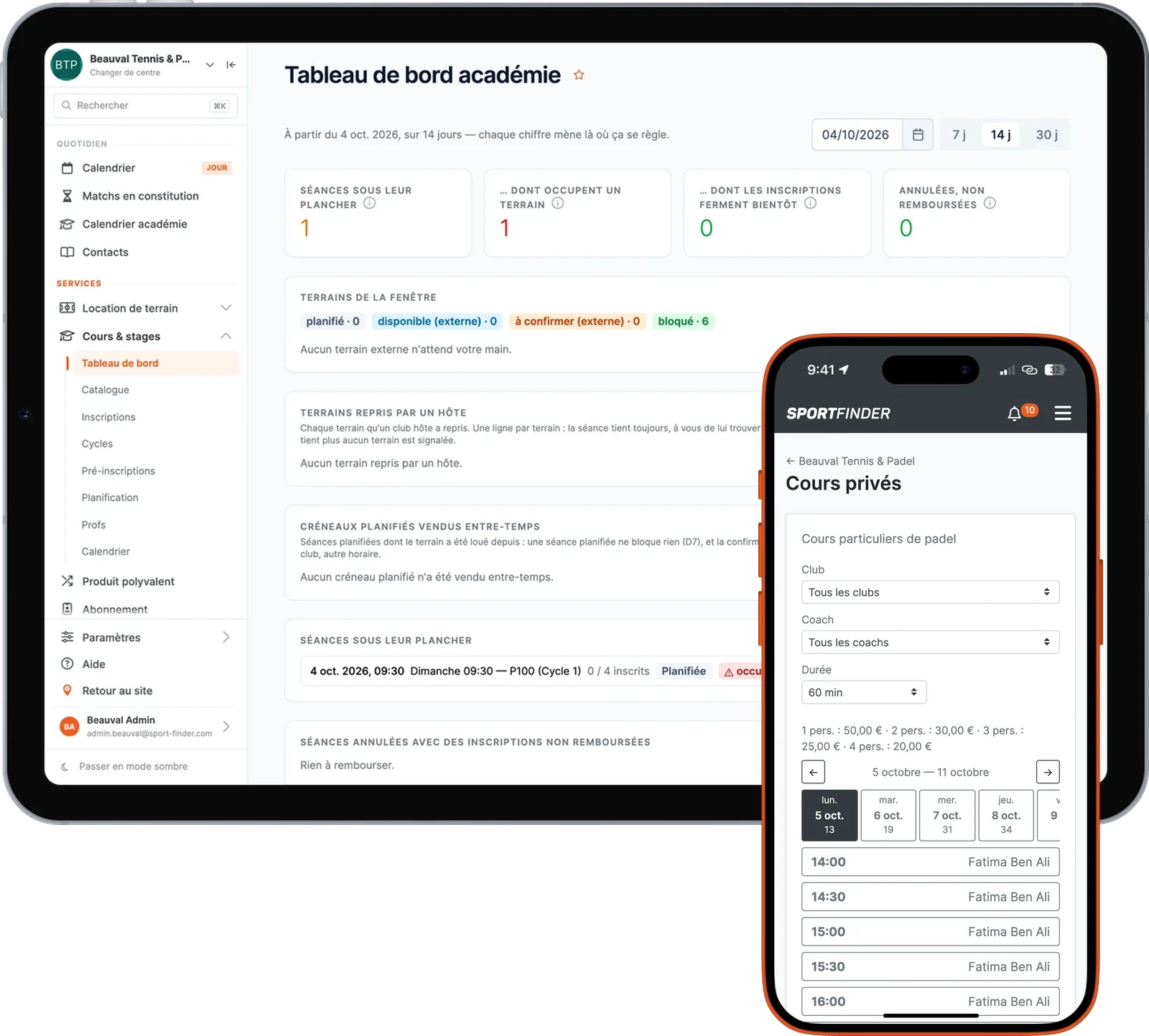
A player’s phone booking a private lesson with their coach, in front of the club’s tablet showing the SportFinder academy dashboard
Who it is for

For tennis schools and padel academies

What SportFinder does for an academy

  • Online registration and payment: holiday camps, season courses, private lessons, single sessions, and pre-registrations with your questions and a deposit.
  • Groups built from real demand: you place the students, and the family accepts its offer with one click.
  • Instructors and courts planned in every club where you teach, with clashes flagged; a session confirms itself as soon as it has enough students.
  • Families kept informed — confirmation, calendar, reminders — and, at the end of the month, each instructor’s hours as an export.

The club with its own school

A few groups or a full programme, tennis and padel, children and adults. No extra software: your lessons live in the same calendar as your court rentals.

The growing academy

Dozens of groups, several instructors, hundreds of students. You read demand before building groups, and each instructor sees only their own lessons.

The academy that teaches elsewhere

You teach at several clubs, on SportFinder or not: one timetable for all of them.

Independent academies

One academy, several clubs

Teaching at other people’s clubs? The software belongs to your academy, not to a club: it follows you into every club where you teach, whether or not it is on SportFinder.

One timetable, by court or by instructor, across all your clubs. At the end of the month, nothing left to piece together: each instructor’s hours and what you owe each host club on SportFinder, as a CSV export.

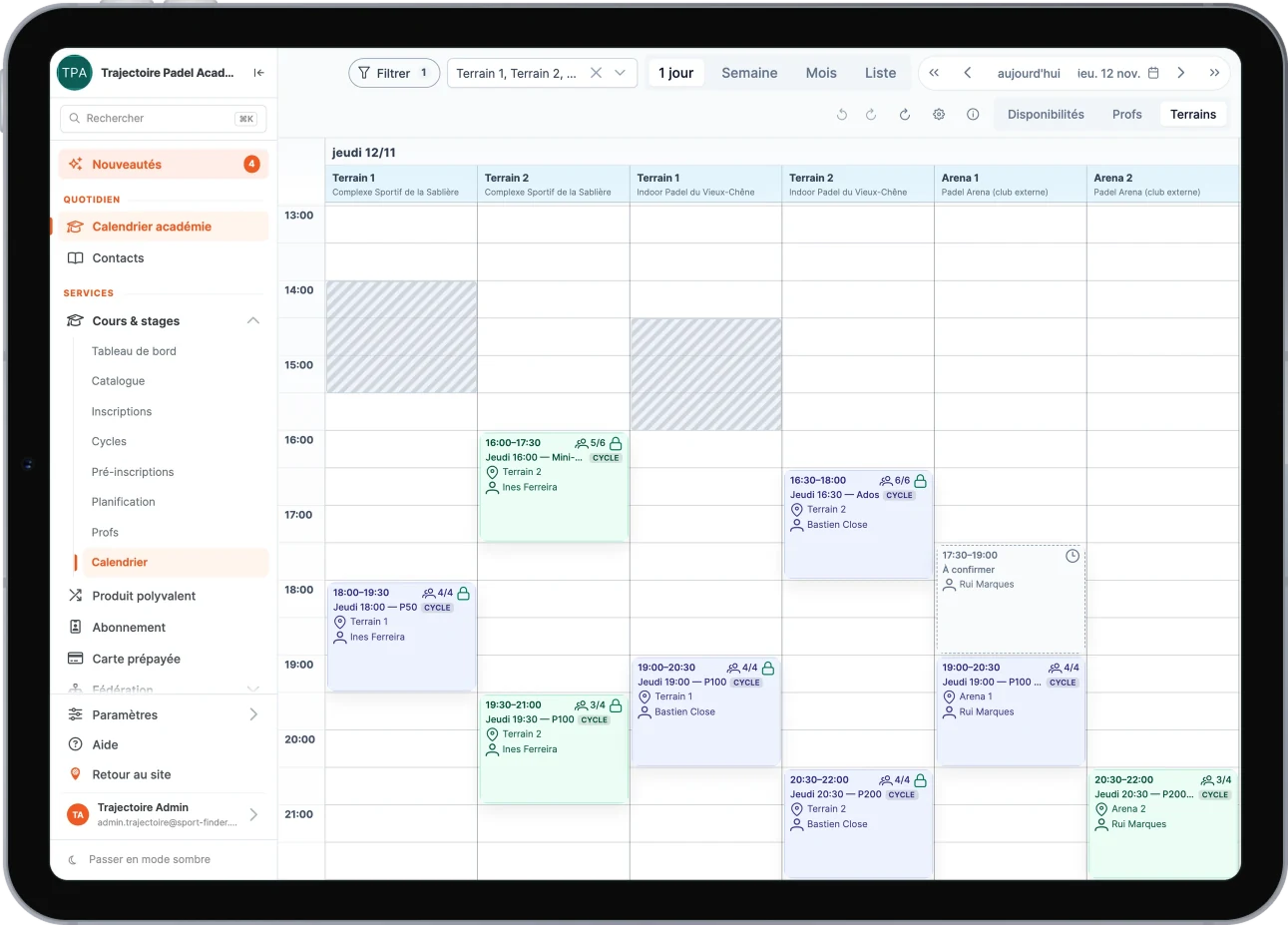
An academy’s timetable in SportFinder, Courts view, on a Thursday: six courts from three clubs side by side. At the two clubs on SportFinder, the lessons carry a padlock and whatever the club has already taken appears hatched, with no name; at the club using another system, a “To confirm” slot is waiting to be booked there
One timetable, three clubs side by side. At the two clubs on SportFinder, the lesson blocks its court (padlock) and whatever the club has already taken shows as busy, never by whom. At the club using another system, the slot stays “to confirm” until you have booked it there. Screenshot taken at our demo academy.

At a SportFinder club

  • A confirmed lesson books its court by itself, at the rate agreed with the club.
  • At an equipped club, access codes and lighting work just as they do for a rental.
  • The club sees its court taken by your lesson, in its own timetable — without seeing your students or your prices.

At a club using another system

  • The club’s courts also appear in your timetable.
  • You book them in the club’s system, then confirm in SportFinder.
  • Nothing overlaps in your timetable: a confirmed court never hosts two of your lessons at once.

SportFinder links your clubs to your academy when we open your account. There is no synchronisation with another club’s system: at that club, you book just as you do today.

For your students

Online registration, as your students experience it

Choose what you sell. Each journey was run end to end at our demo club, from the first screen to confirmation.

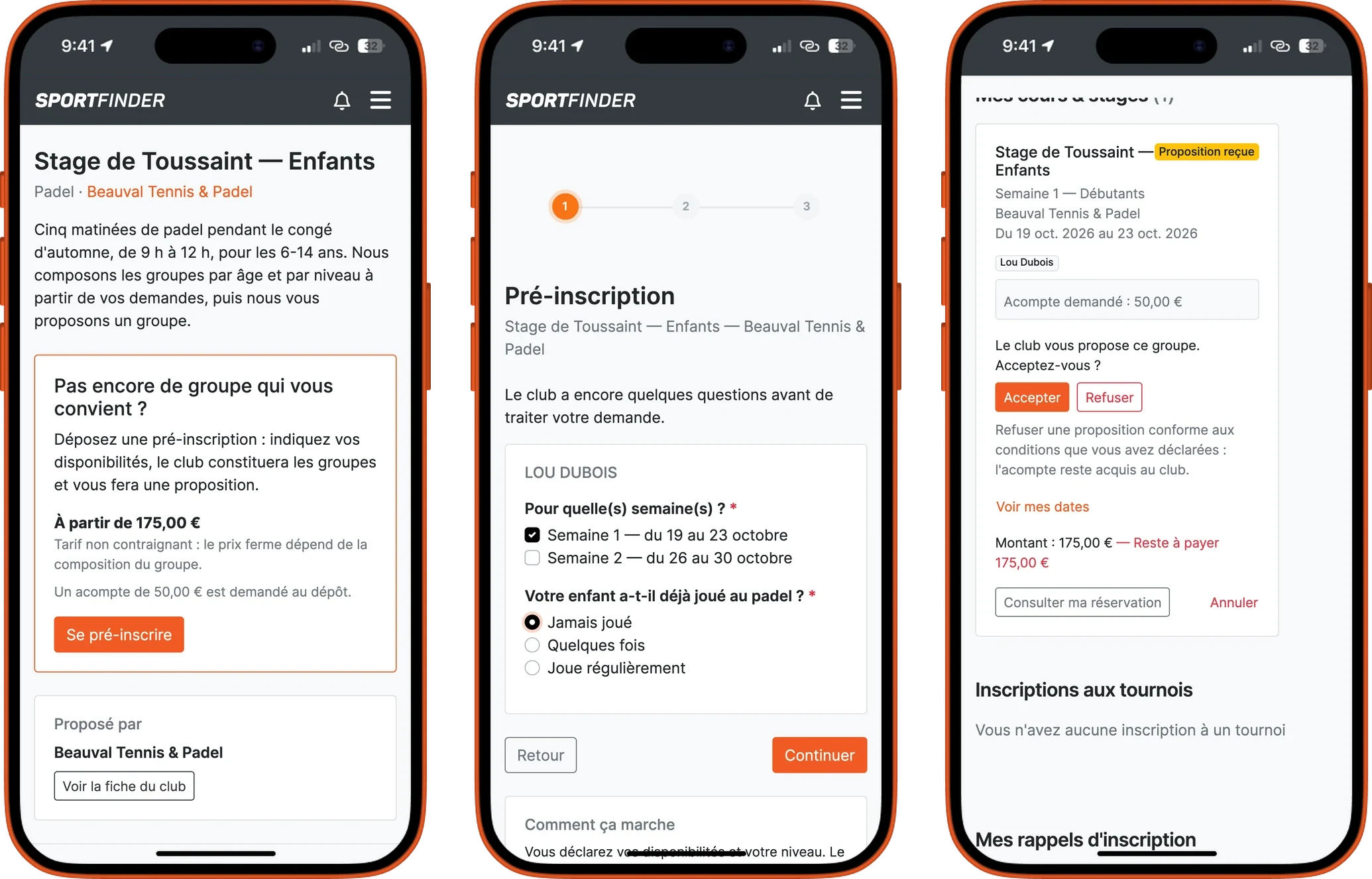
Three phone screens: the page of an autumn half-term camp, the club’s questions at sign-up (the week, the child’s experience), then the group offer received by the family, with Accept and Decline buttons
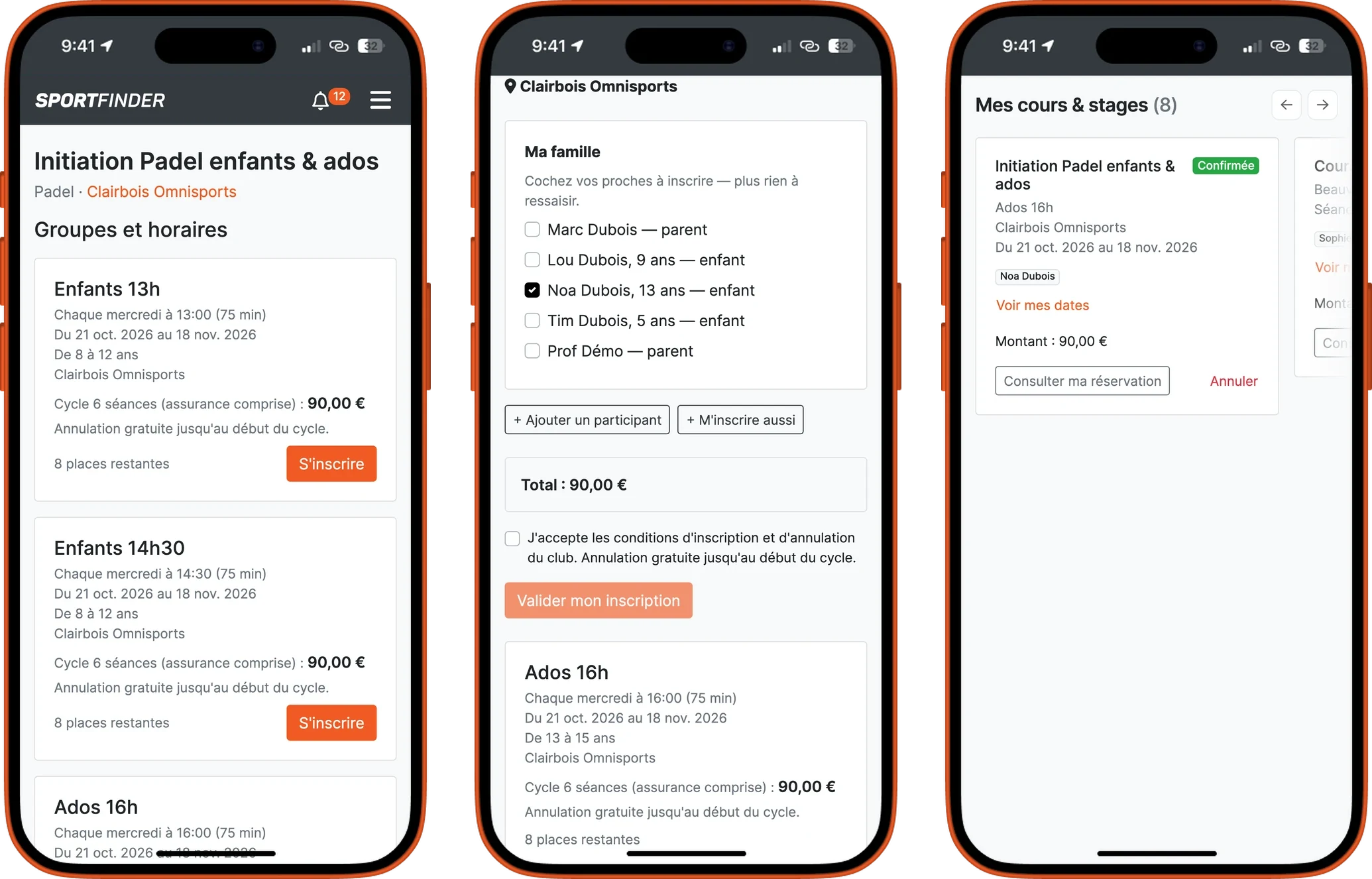
Three phone screens: a course’s groups with their times, ages and places left, a parent ticking their child in their family, then the confirmed registration in their account
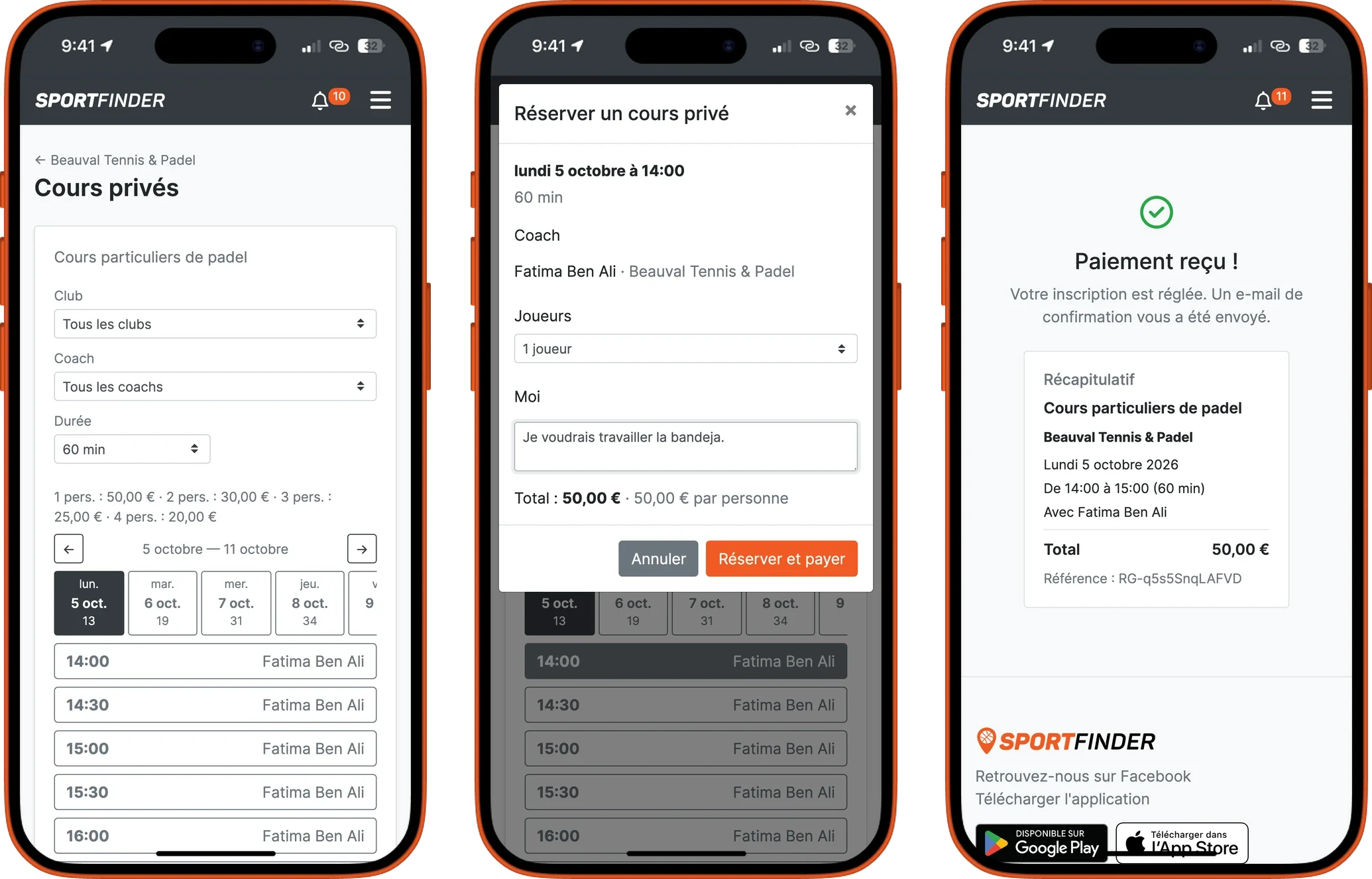
Three phone screens: a week’s free hours with the coach’s name, the booking panel (coach, duration, number of players, price per person, a note for the coach), then the lesson confirmed in the player’s account
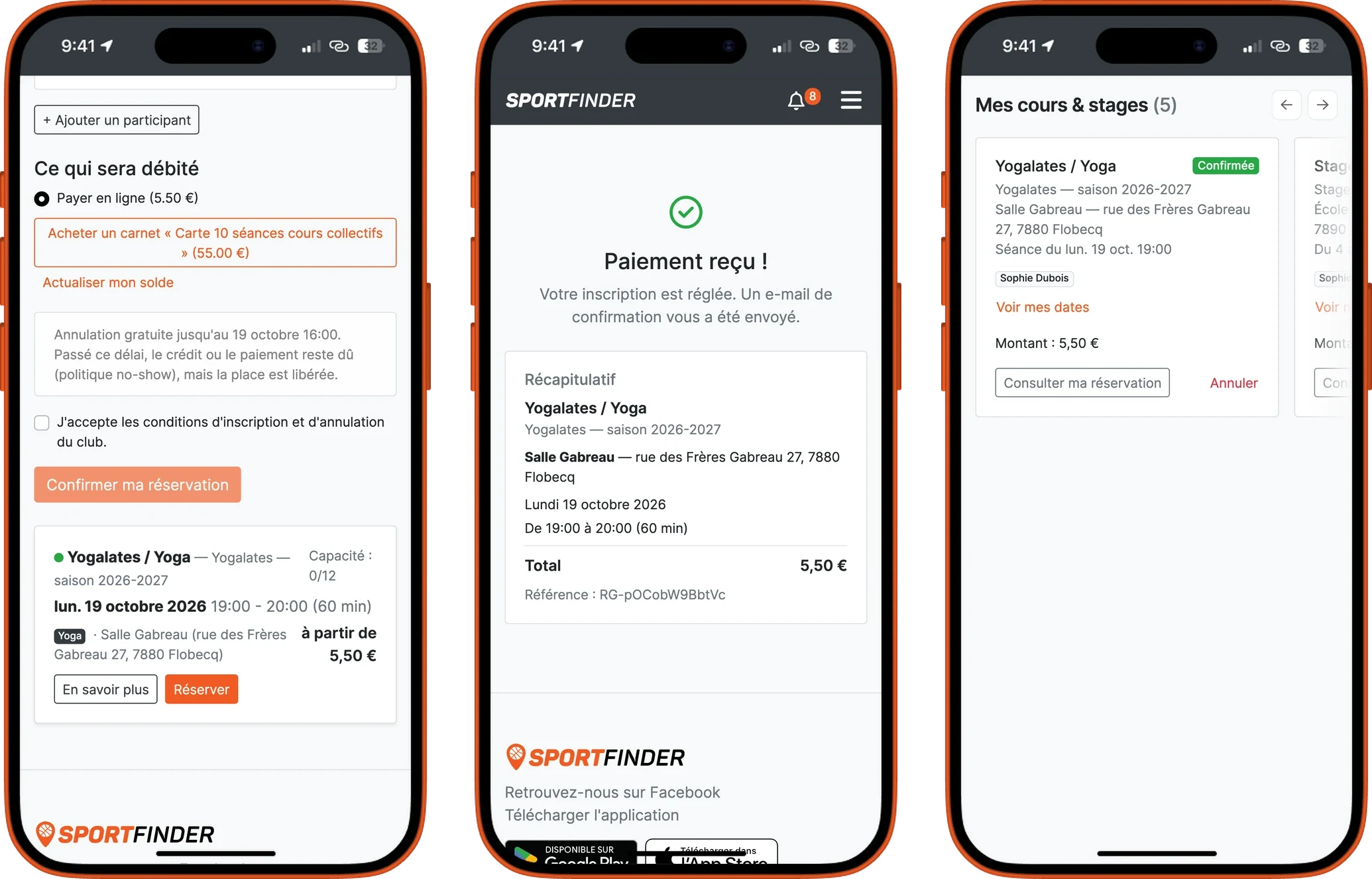
Three phone screens: booking a single session with the cancellation rule and the club’s prepaid card, the payment, then the session confirmed in the player’s account
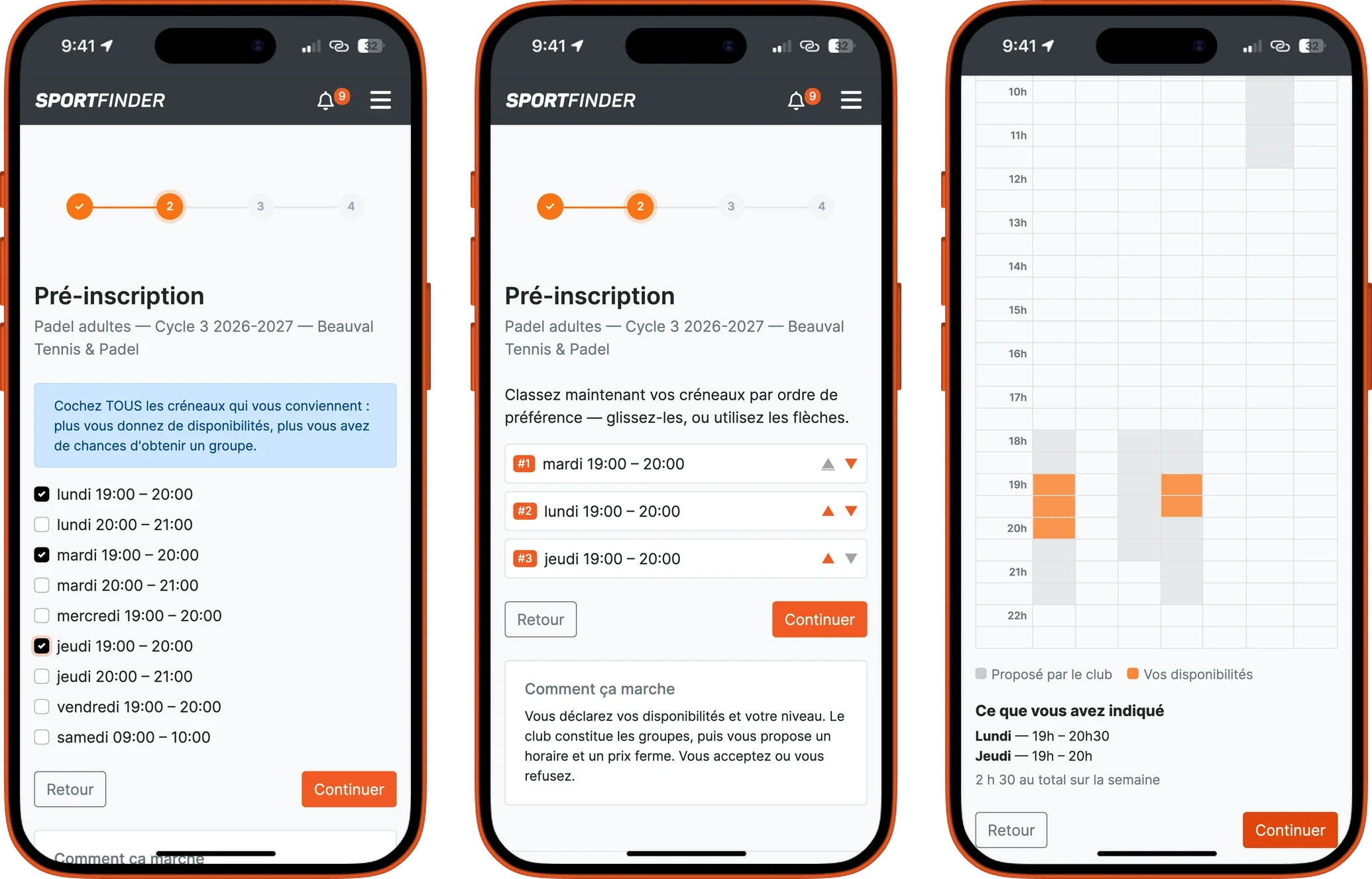
Three phone screens: the player ticks the slots that suit them, ranks them by preference, then sees their conditions before submitting their pre-registration

The family chooses its week and answers your questions. You build the groups; the family receives its offer and accepts it with one click.

The parent signs their child up from their own account, with no email address to invent for a nine-year-old, and pays online.

The player chooses their coach, their time and the duration. A slot only appears if the coach is available and a court is free.

To try before committing: a single session, paid online or deducted from a prepaid card.

Before any group exists, the player ticks the slots that suit them and ranks them. Or they colour in their week, if you open free ranges.

  • Everything in one place: in “My courses & camps”, the player sees their dates, their balance, the offer to accept, and can cancel within the deadlines you set.
  • Emails go out automatically: registration confirmation, session reminder, and “Your lesson is confirmed” as soon as the lesson has enough students, a court and an instructor.
  • The dates go into their calendar: one link adds every session to the calendar on their phone.
  • You write to every family at once: a balance reminder, a practical update, by email, text message or WhatsApp link — without copying out a list.
What you sell

Everything an academy sells

Courses over a season

You set the rhythm once — Tuesdays at 19:00, for so many weeks — and the sessions are created automatically. Any single session can then be moved.

Holiday camps

Mornings or full days, over a week. Your sign-up questions — the week, the menu, allergies — are tallied automatically and can be exported; groups are built afterwards, by age and level.

Private lessons

Booked online by the player, with the coach of their choice, for the durations you offer, alone or with others.

Single sessions

A taster session, a catch-up, or selling by the session: paid online, or deducted from a prepaid card.

Front-desk registrations

The parent who drops by reception, the lesson booked over the phone: you enter it, and a payment link goes out if needed.

Just a listing

Not ready to sell online yet? Your lessons still appear, with a button to call you, email you, or go to your own page.

A price for every lesson

  • Each type of lesson has its own rate: private lesson, group lesson, camp, trial session.
  • A private lesson is priced by group size: for example €60 alone, €30 each for three. The player sees their price before booking.
  • A season course resells the places that free up: a freed place goes back on sale by the session, for a drop-in player.

Payment by bank card, Apple Pay or Google PayBancontact, bank card, Apple Pay or Google Pay, or with the credit the player holds at your club; a deposit at pre-registration if you wish; prices by age, by municipality or by group size.

In your back office

Building a season’s groups in five steps

Collect demand first, build the groups second. No more slicing your timetable by age and level and hoping registrations land in the right boxes.

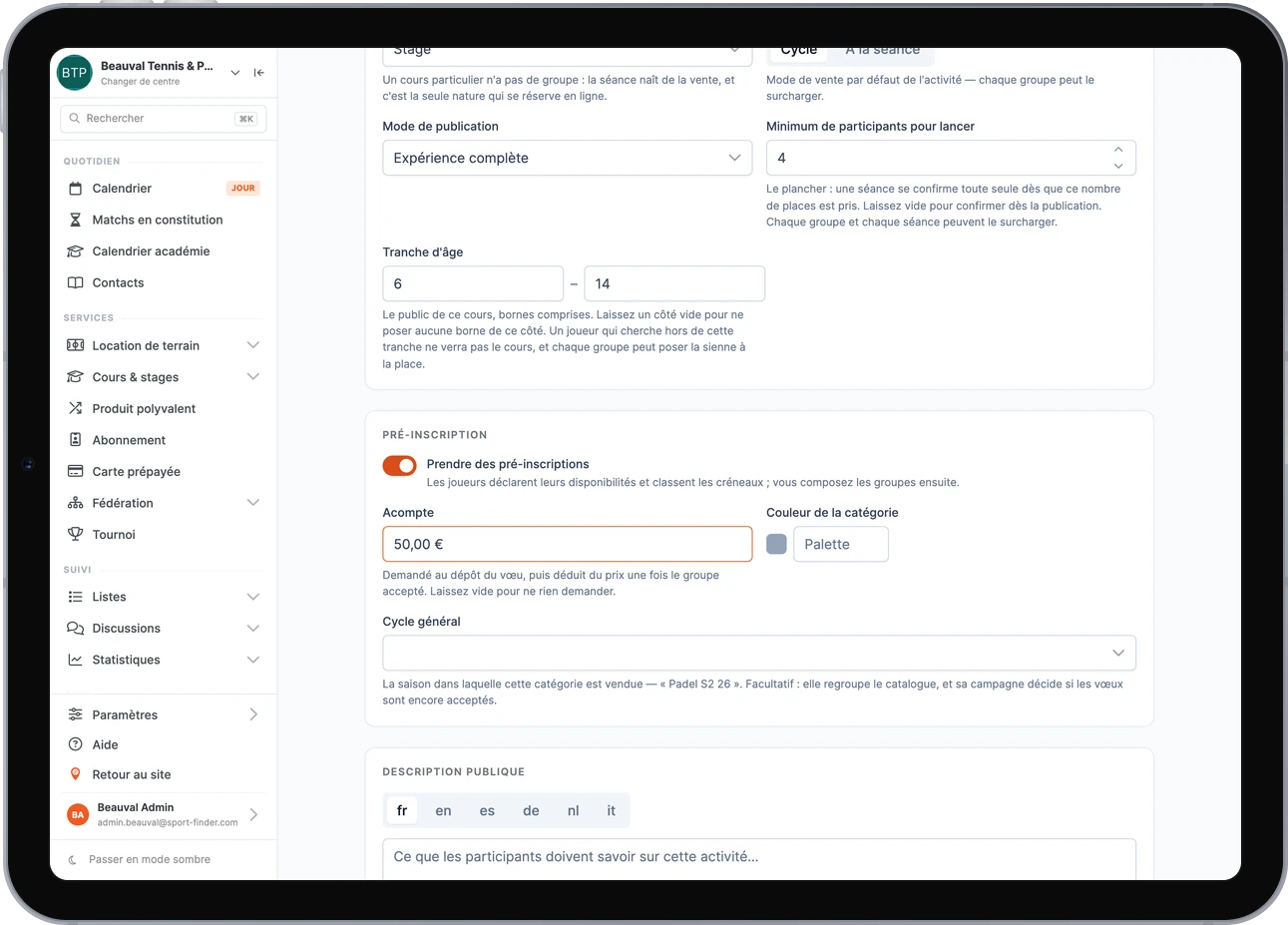
An activity form in the SportFinder back office: the “Take pre-registrations” switch and the deposit amount
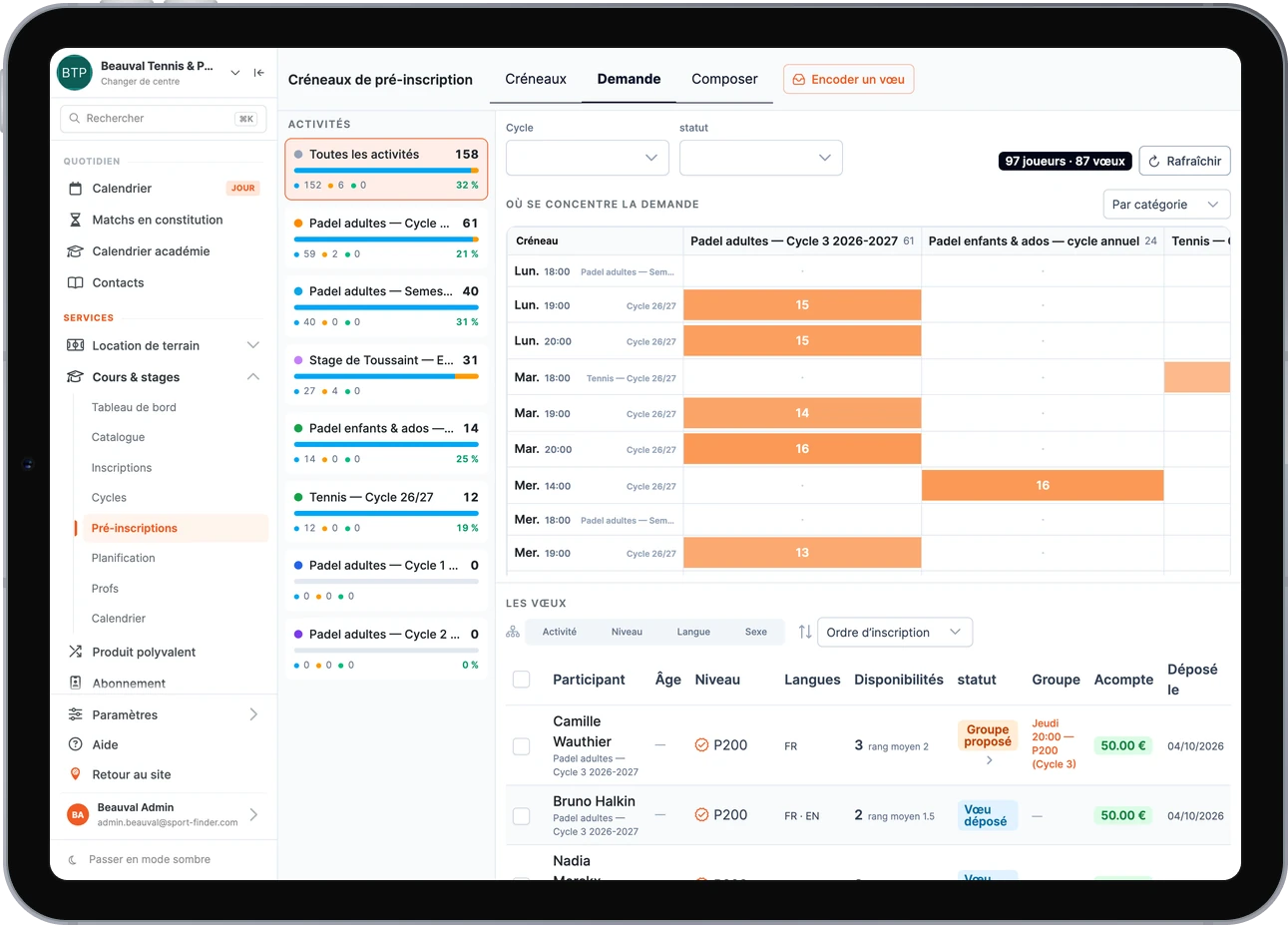
Pre-registration demand in SportFinder: a grid crossing the week’s slots with the categories, coloured by the number of players who want each slot
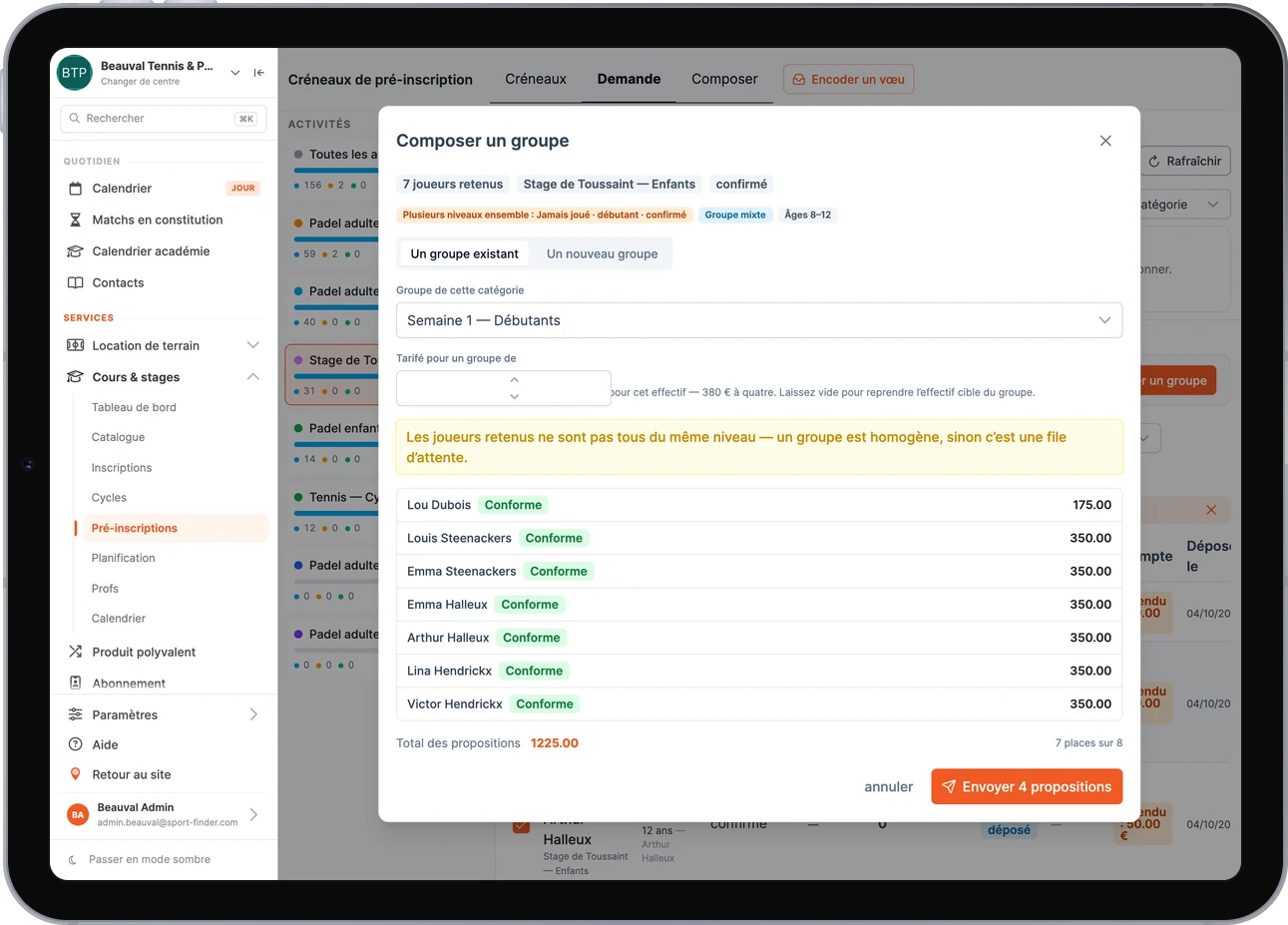
The SportFinder “Compose a group” dialog: seven players selected, each marked as matching what they declared, and an alert flagging mixed levels before sending
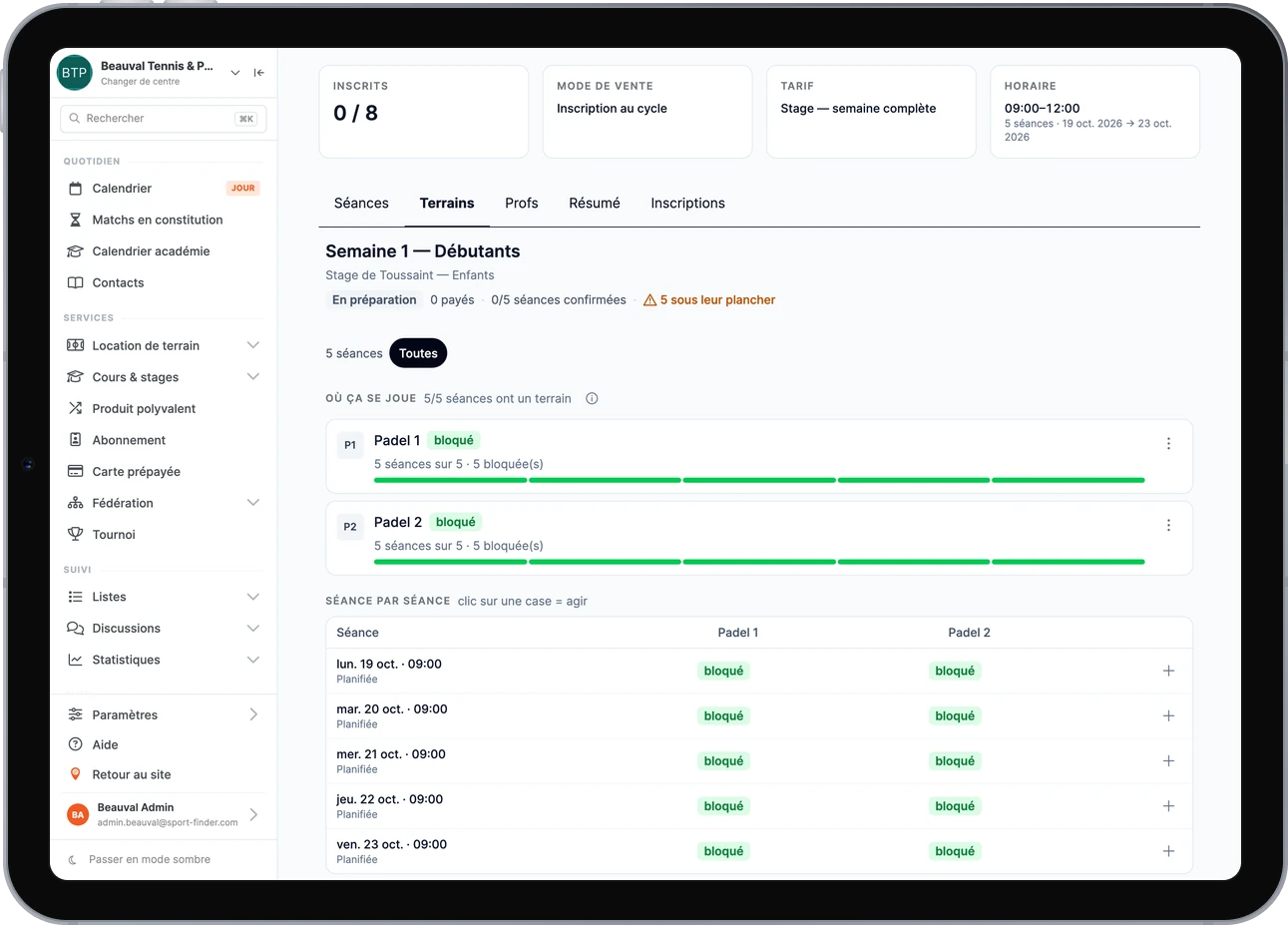
The Courts tab of a group in SportFinder: two courts marked blocked across the camp’s five sessions
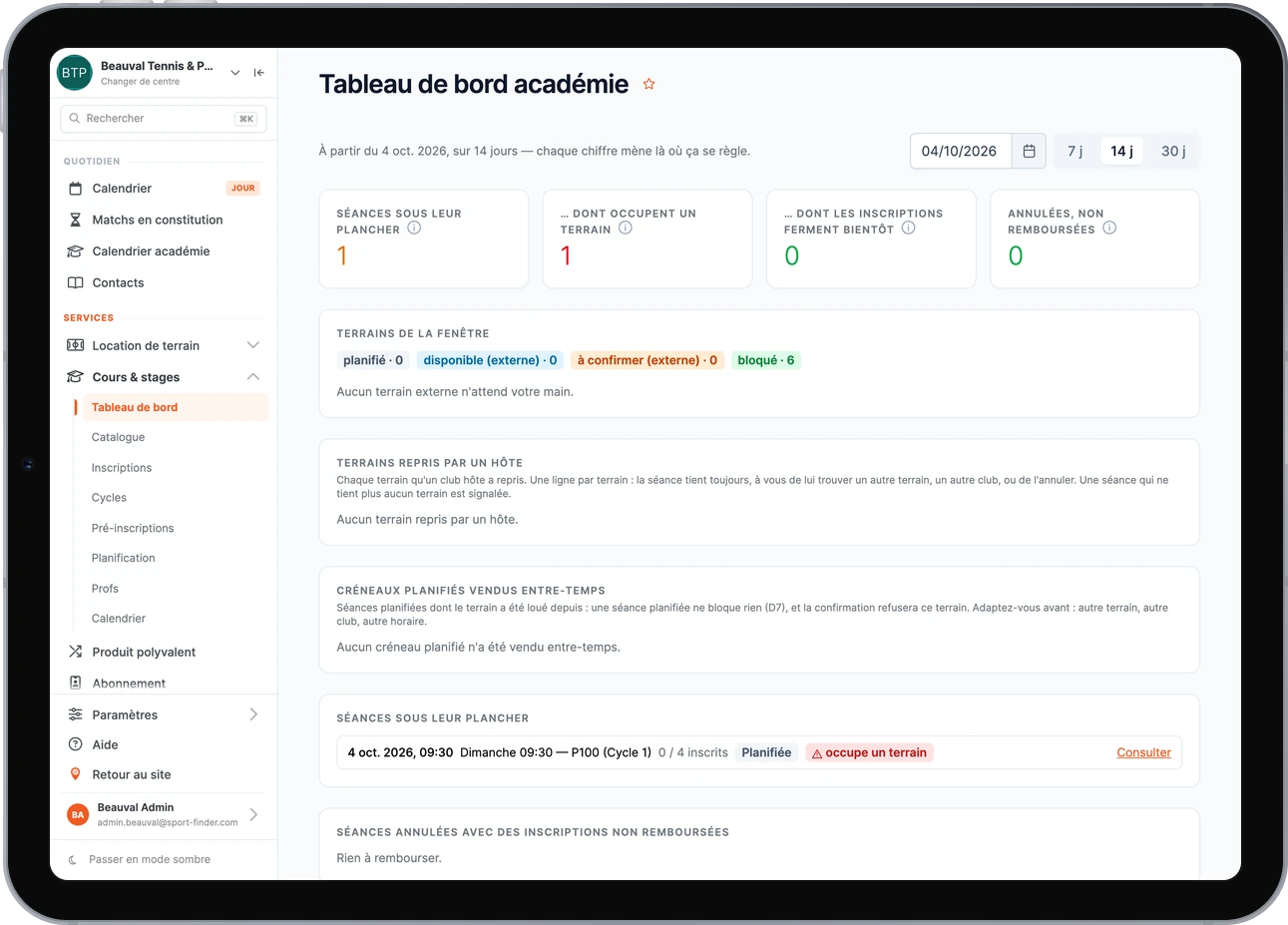
The SportFinder academy dashboard: over the next fourteen days, sessions under their floor, those holding a court, registrations closing soon and cancellations to refund

You open requests before you have a single group, with or without a deposit, and you ask your own questions.

Before fixing anything: how many players want each slot, category by category.

You pick players, and the software tells you whether the group holds up: mixed levels, numbers, offer matching or not. Then you send all the offers at once.

Each session holds its court, like a rental. Planned, it blocks nothing; blocked, nobody else can book it.

The next fortnight: what is short of students, what is holding a court, what is left to refund. Each figure leads to where it gets sorted.

Building a season’s groups in a spreadsheet takes weeks. Here, it takes a few hours.

Lessons and rentals

A lesson really occupies the court

  • Numbers decide: each session has its floor. As soon as it is reached — online or front-desk registrations — the session confirms itself.
  • A confirmed session blocks its court: nobody else can book it for that hour.
  • While it is only planned, it blocks nothing: a season still being worked out does not cost you your week of courts. And you can block a group’s courts earlier, with one button, if you want to hold them.
  • One definition of “occupied”: lessons, rentals, tournaments and maintenance blocks all count in the same place. Nothing to reconcile between two timetables.
  • School holidays, declared once: the dates they cover are unticked when you set up a season, and the calendar flags the sessions that fall within them. A closure warns, it never deletes anything. Wallonia-Brussels and Flanders no longer share the same school holidays: you enter your own students’ dates, nothing is taken from a national calendar.
Your instructors

Each instructor has their own week

  • Their availability, declared: agreed in advance for some hours, on request for others. Cover in their pre-agreed hours confirms itself; outside them, it waits for their answer.
  • Their own access, if they want it: they see their sessions and answer cover requests, without seeing the rest of the club.
  • Their hours, counted: the monthly statement says how many hours they taught, and where.
  • Video, on order: with Padel Stats AI, a PadelDev product, the videos from the court cameras are linked to the student and their session, and the instructor reviews them with the student.
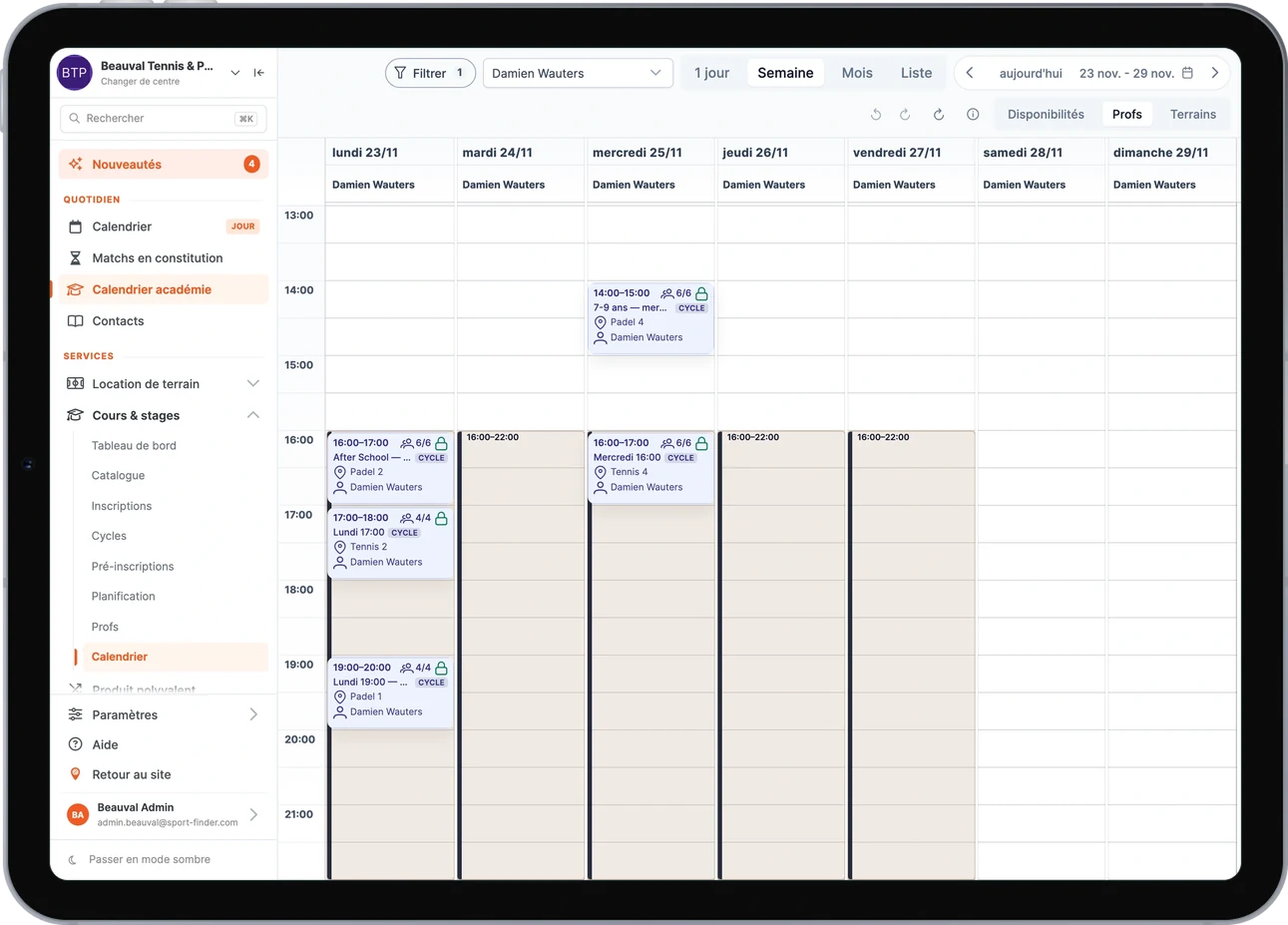
The SportFinder academy calendar in Instructors view, over one week: the availability windows declared by one instructor, from 16:00 to 22:00, and their lessons with their court and numbers
The right question

A lesson is a court sold in advance

For a club, a school fills the hours that rentals leave empty: Wednesday afternoons, early evenings, weekdays. For an academy, it is a season sold in advance — without anyone picking up the phone.

  • Off-peak hours that become courses: your least-sold slots are the ones best suited to a regular lesson.
  • Cash that arrives before the season: the deposit at pre-registration, the balance on acceptance.
  • Players who find you: your lessons appear in the SportFinder search, by sport, region, age and day — enough to complete a group without chasing anyone.
  • Figures you can track: academy sales have their own view in your statistics, month by month.

We work out what it means for your club together in the demo, using your data — our prices are already published.

TV screens

Your camps on the club’s screens

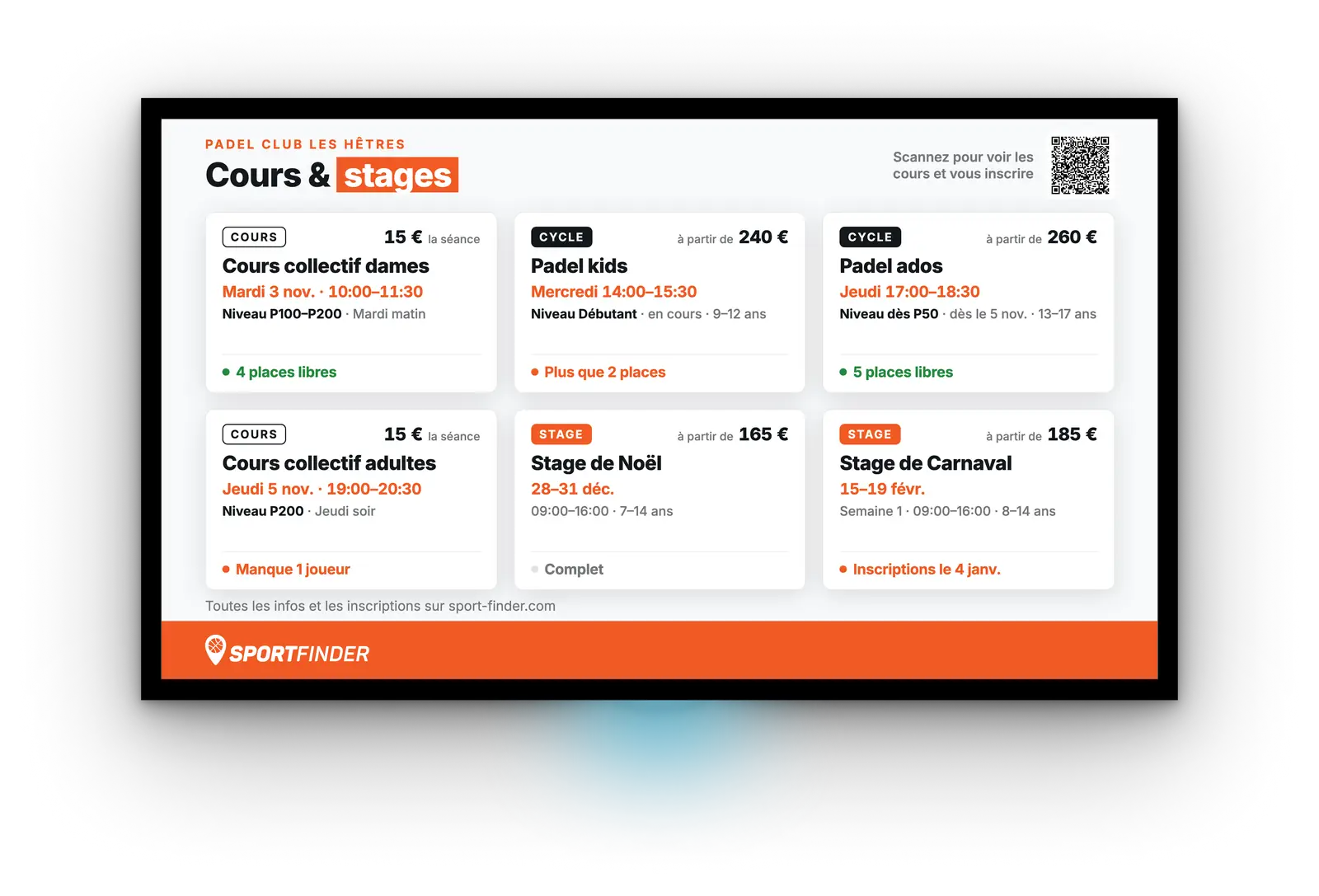
  • What is starting at your club: your next camps and season courses, three to six cards, with the times, the ages, the level when you have set one on the group, the “from” price and the places left — down to “Full”.
  • Your group lessons, session by session: a course sold per session shows as its next session, with its level, its price per session and, until the minimum is reached, how many players are still needed. Everything is read again from your timetable each time the slide comes round.
  • A QR code leads to registration: people scan it from the bar and land on the club’s courses page, to sign up online.
  • In every club where you teach: the slide shows the lessons taught at that club. So a host club on SportFinder shows, on its own screens, the ones your academy teaches there.

It is one of the slides of our TV screens: it takes its place in the club’s rotation, alongside availability and tournaments. Screenshot taken at our demo club.

A club TV screen showing the “Courses & camps” slide: six cards, including two group lesson sessions with their level, price per session, places left or how many players are still needed, then season courses and camps with their times, ages, “from” price and places left, and a QR code to see the courses and sign up
Frequently asked

Running a padel or tennis academy

Do my students have to install anything?

No. Registration happens on your club’s page, on phone or computer: the player creates their account once, then finds all their lessons, dates, balances and cancellations under “My courses & camps”.

My club doesn’t use SportFinder. Can I still use the module?

Yes. Your academy has its own space, which we open for you, and we link it to the clubs where you teach, whether or not they are on SportFinder. At a club on SportFinder, a confirmed lesson books its court by itself, at the rate agreed with the club; the club sees the hours as taken without seeing your students or your prices. At a club using another system, its courts appear in your timetable: you book them in the club’s system, then confirm in SportFinder. There is no synchronisation between the two pieces of software.

Do parents have to create an account for each child?

No. The parent adds their children to their family, with their date of birth, and signs them up from their own account. A child needs neither an email address nor a password — and if they claim their own account later, they keep their registrations.

How do families pay?

Online, by bank card, Apple Pay or Google PayBancontact, bank card, Apple Pay or Google Pay, or with the credit they already hold at your club. You can ask for a deposit at pre-registration, deducted from the price when the family accepts your offer. And if you prefer to take payment at reception, an activity can take online registrations without payment.

How much does the academy module cost?

Our prices are published on our pricing page, and the academy module is listed there. A registration paid online is an online sale: like any online sale, it carries a commission. What your lessons can bring in, we work out together in the demo, on your figures.

Do my instructors get access to the software?

If they want it. An instructor can be just a name on the timetable, or have their own access: they see their sessions, declare their availability and answer the cover requests sent to them, without seeing the rest of the club. At the end of the month, their statement shows how many hours they taught.

Will I know three days ahead whether my Tuesday lesson has enough students?

Yes. Each session has its floor — the number of places it needs to run — and it confirms itself as soon as that is reached. The academy dashboard lists, for the days ahead, the sessions still below it — and those already holding a court.

Does a lesson really block the court for rentals?

Yes, as soon as the session is confirmed: its court goes into the same engine as your rentals, tournaments and maintenance blocks, and nobody else can book it. While it is only planned, the court is shown without blocking anything — and you can block it earlier, with one button, if you want to hold it.

Fixed slots or free ranges — do I have to choose?

It’s a setting on the season course. Either you publish your slots and players tick and rank them, or you open wider ranges: your players colour in the hours when they are free, and you see where demand really lies before fixing the timetable.

What if a family turns down the place we offer?

The place goes back into your group building. The deposit depends on your offer: if it respected what the family had declared, the club keeps the deposit; if not, it is refunded. The software tells you, before sending, whether an offer matches the request.

Can two friends be in the same group?

Yes, you place them together when you compose. However, families cannot yet link their request to a friend’s: you stay in control.

Can I use my own level system?

Federation rankings are already set up: the player enters theirs when signing up, and if they are ranked, their level is read at the source and then locked. For your beginners, you can also create your own scale.

What about school holidays?

You declare your closures once. While you set up a season, the dates they cover are unticked automatically; afterwards, the calendar flags the sessions that fall within them. A closure warns, it never deletes a session — a camp that runs precisely during the holidays needs no exception. In Belgium, the Wallonia-Brussels Federation and Flanders no longer have the same school holidays: you enter your own students’ dates, no national calendar is imposed.

What is still in development?

Three things, none of them delivered, dated or charged for yet. Player progress tracked by their instructor: progress and points to work on, attached to the player’s record. Connected instructor calendars: instructors will connect their personal calendar, and their unavailability will drop out of the timetable. Priority at a host club: beyond a deadline you set, the court at the venue hosting you will confirm without intervention.

The module lives in the same back office as everything else: online booking, payments and statistics apply to your lessons too.

30 minutes to build a camp with us

Bring your academy’s spreadsheet and the list of your clubs: we open a camp, watch the requests come in and build a group in front of you, with your levels and your courts. You’ll see it working before you decide anything.