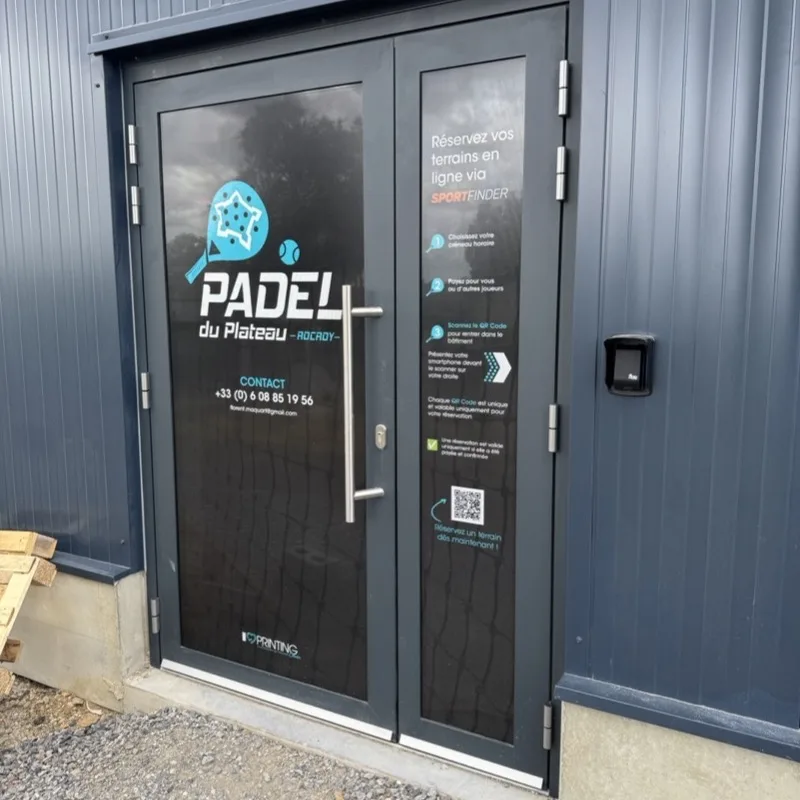
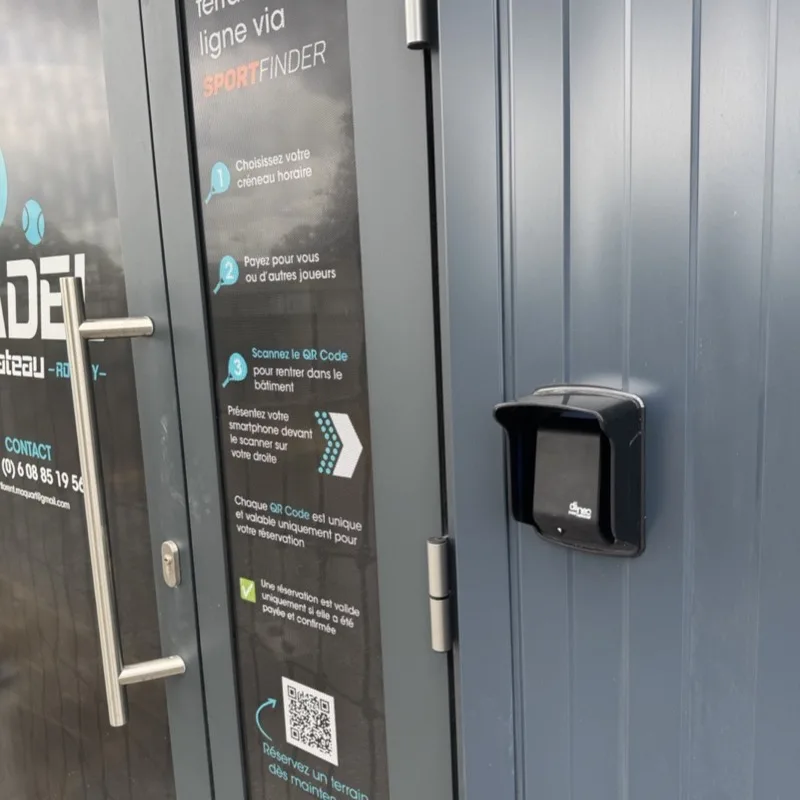
The booking does it: it unlocks the door for the first player, lights the court,
and closes behind the last one. Meanwhile you are somewhere else — and the club
keeps selling slots.
15 / 5 mintolerance before / after the slot, by default
A day in the life
A club that runs with nobody there to open it
Nobody came to switch on a light or turn a key. Every one of these was triggered by a
booking.
06:45The first player scans their QRthe door opens, and the court is already lit if it is still dark
All dayEvery booking opens its own window15 minutes before, 5 minutes after the slot — with nobody validating anything
19:30The coach arrives with a groupthe door stays open 30 minutes longer, automatically, because a member of the “Coach” group is on the booking
22:10The last match runs a few minutes overthe lights stay on for up to 5 minutes more, long enough to pack up, then go out on their own
Nobody opened, lit or closed the club today. And all of it worked.
How it works
The code is born from the booking
One code per booking, or per player: at purchase, a unique QR (or code) is generated, tied to the whole booking or to each participant, depending on your settings.
An adjustable tolerance window: 15 minutes before and 5 minutes after the slot by default — and you change those values, product by product.
The code only appears once free cancellation has passed: no key is ever handed out for a booking that could still be cancelled.
Offline at the door, genuinely: standalone hardware calculates and validates the QR on the reader itself, without ever calling our servers. Connected solutions generate the code through the supplier’s API; and the scanner app your staff use calls the API on every scan — it needs the internet.
An encrypted QR, not an identifier in the clear: on the most capable standalone hardware the code carries its validity window, its access categories and its hardware instructions, encrypted with a key specific to your club — unreadable and unforgeable if intercepted.
Two schools of thought
And at your club, the lights come on when?
On paper everyone wants an unmanned club. On the ground there are two schools — and
each has good reasons.
Everything ready before the player
The door is unlocked, the court already lit: the player
walks in and plays, without taking out a phone or keying anything in. No handling
at all, from arrival to first serve — the club looks like it was expecting them.
Nothing comes on without a deliberate act
The court stays dark until a scan at the door confirms that
somebody is actually there. It is the choice of clubs with memberships and free
entitlements: a ghost booking made “just in case” lights nothing, burns nothing —
and the blocked court stays visibly empty, so the abuse shows.
Both schools hold up, and our position is not to decide for you: each behaviour is
configurable, club by club and product by product. That is what access control in the
service of the club looks like — rather than the other way round.
Smart lighting
The system does not watch the clock. It watches the sky
Depending on the hardware installed, lighting follows the real sunset and sunrise at
your club — calculated from its exact GPS coordinates, not from a fixed timer that
stays the same all year.
An astronomical calculation, not a timer: the site’s sunset and sunrise are recalculated every day from its position, with configurable margins to bring the lights on earlier or later.
The manager sees the result, not an abstraction: the back office says “lights on at 20:30, off at 06:00 tonight”, with the margins applied spelled out.
Tested across the daylight-saving switch: the night window stays correct despite the one-hour shift — an automated scenario checks exactly that.
Post-match grace: if a match runs into the night, up to 5 extra minutes of light, long enough to pack up and get out.
Targeted rules: each instruction can address a sport, a resource, a group of contacts or a precise time band, with a priority — it is the same engine that fires the “coach” rule in the day above.
One engine drives the door, the lighting, the hot water in the showers and the car park — from the same booking data, with no second system to keep in sync.
Your hardware
Your door, your hardware
Not a single reader repainted in SportFinder colours. A club that is already equipped
keeps its hardware instead of replacing everything to join us.
Access control is usually sold as a closed package: one price tier, one supplier, one
reader. We work with the market’s main solutions instead, and we tell you which family
fits your door.
01
Standalone hardware, offline
The reader calculates and validates codes locally: the door opens even with no internet connection. The most capable also drives lighting, hot water and the car park, through a single rules engine — priorities, groups, time bands, real sunset.
02
Connected solutions
The access code is generated by a call to your hardware supplier’s API. One of those integrations was born on a public tender: the municipality was already equipped, and we worked with its installation rather than re-equipping it.
03
Code padlocks
The simplest of all: one fixed code per padlock, changeable in a click, with a different code per sport on a court that carries several.
And separately from door hardware there is the SportFinder QR: a code scanned by
hand by your staff, on their own phone — made for pools, parks and pay-per-entry
gates, with no dedicated reader to buy. It is a system in its own right, not a hardware
integration.
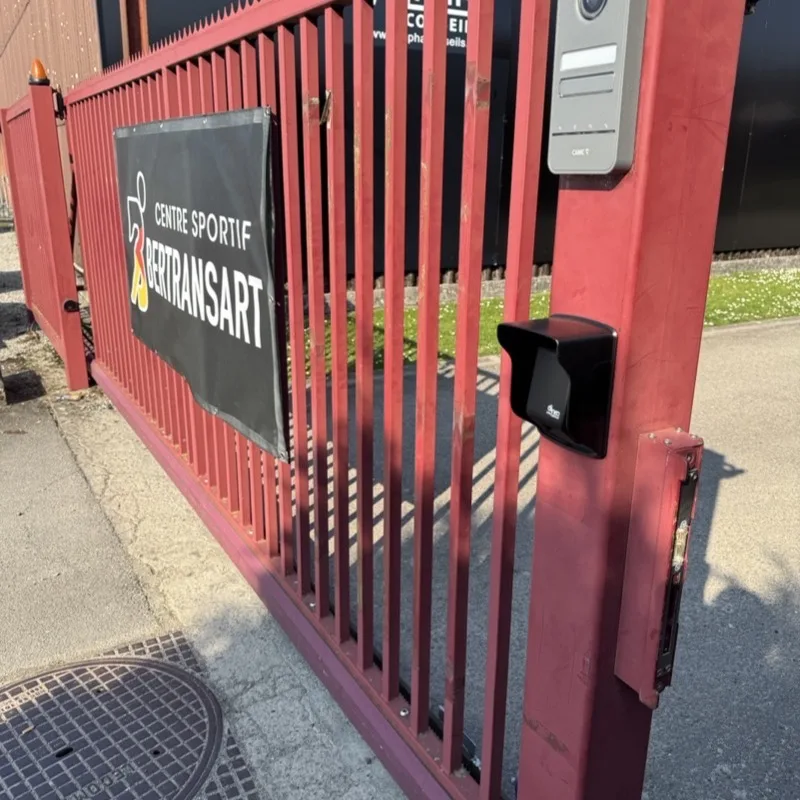
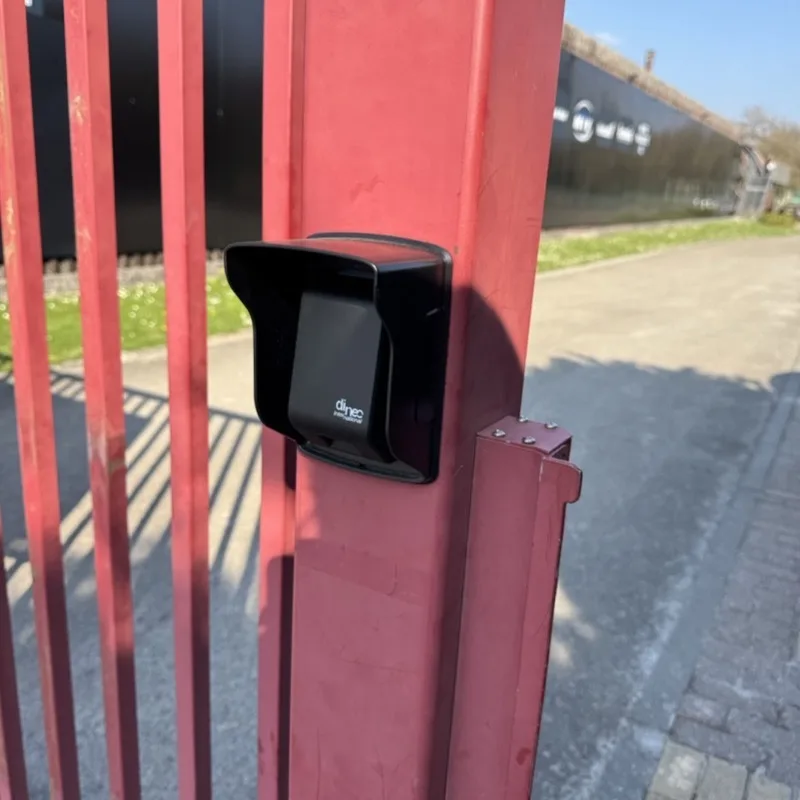
On site: the gate of the Centre sportif du Bertransart and its QR code reader, opened
by the booking.
Solutions exist for your door and your building — we point, we do not impose. The
structure of our pricing is public.
Security and audit trail
Every scan is logged
Every access attempt — granted, refused or exhausted — is recorded with the operator, the time and the reason, and is readable in the back office.
A refused scan never consumes an entry: your customer keeps their remaining accesses even after a mistake.
A dedicated “access control integrator” role configures the doors without ever seeing a booking, a contact or a payment — even the club manager does not hold that right by default.
Anti-fraud at protocol level: an unknown or out-of-scope code returns exactly the same “not found” answer — there is no way to probe for the existence of a code from outside.
Changing hardware locks nobody out: regenerating a centre’s codes takes one click, and the old codes stay valid until they expire naturally, giving everyone time to receive the new one.
08:12 — Court 2Granted
08:47 — Court 4Granted
09:03 — Court 1Refused — outside slot
Frequently asked
Access control: what clubs ask us most
Do I have to replace my installation to move to SportFinder?
No. SportFinder works with the market’s main access solutions — standalone hardware, connected systems or a plain code padlock: you keep what you already have. That is actually how one of our integrations came about: a municipality was already equipped under a public tender, and we worked with its installation instead of re-equipping it.
Can the lights come on only after a scan?
Yes. Some clubs want everything ready before the player arrives; others insist on a deliberate action at the door, so that a booking nobody honours never lights an empty court. Both behaviours are configurable, club by club and product by product.
What happens if the internet goes down?
Standalone hardware calculates and validates codes offline, without ever calling our servers: the door opens with no connection at all. Connected solutions generate the code through a call to the supplier’s API. And the scanner app your staff use needs the network to validate each scan.
Who can configure the doors and the lighting?
A dedicated “access control integrator” role, which sees no bookings, no contacts and no payments. Even the club owner does not hold that right by default: changing the door configuration stays with that role.
Can I revoke a QR code already sent to a player?
A code that has been generated and handed over cannot be invalidated — it is the equivalent of a copied key you no longer control. You can regenerate new codes at any time; the old ones stay valid until they expire naturally.
Does access control work for a pool or a fitness room too?
Yes, through a dedicated entrance product: multi-entry passes — a ten-session card, for instance — with one code per booking or per participant, depending on how much traceability you need.
How much does the hardware cost?
It depends on your door and your building: we point you in the right direction, we impose nothing, and we quote for your case. The structure of our pricing — subscription, modules, hardware — is public.
Thirty minutes to see your club open by itself
Your door, your hardware, your opening hours: we look at what you already have and
tell you straight what it takes.